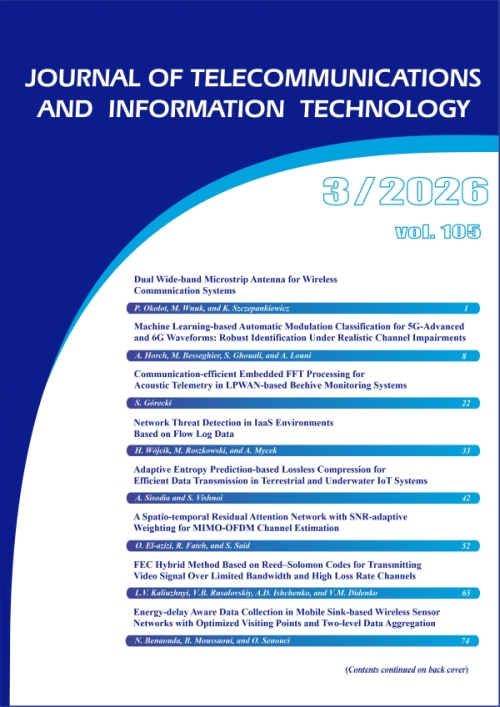
A Spatio-temporal Residual Attention Network with SNR-adaptive Weighting for MIMO-OFDM Channel Estimation
DOI:
https://doi.org/10.26636/jtit.2026.3.2688Keywords:
channel estimation, deep learning, MIMO-OFDM, NLMS, NMSE, residual attention, Rician fading, RLS, SNR-adaptive weightingAbstract
This paper addresses channel estimation in MIMO-OFDM systems under time-varying Rician fading and spatially correlated propagation conditions, where reliable coherent detection requires accurate channel state information. Although least-squares (LS) estimation is simple and computationally efficient, it remains highly sensitive to noise. In addition, conventional deep learning-based estimators may suffer from tracking bias when temporal channel variations are not properly handled. To overcome these imitations, this paper proposes SMART-CE, a spatio-temporal residual attention network with SNR-adaptive weighting. The proposed approach refines a sequence of LS estimates by extracting spatial-frequency features, exploiting temporal channel correlation, and adaptively balancing historical and current channel information according to the operating SNR. The final channel estimate is obtained through a residual correction of the current LS estimate. Simulation results on an 8 x 8 MIMO-OFDM system show that SMART-CE generally achieves lower NMSE and BER than CNN, residual CNN, residual-attention CNN, recursive least-squares (RLS), and normalized least-mean-square (NLMS) baselines, with the most pronounced gains observed in the low-to-medium SNR regime.
Downloads
References
[1] I. Almeida, J. Guerreiro, and R. Dinis, "On Deep Learning Hybrid Architectures for MIMO-OFDM Channel Estimation", Electronics, vol. 14, art. no. 4692, 2025. DOI: https://doi.org/10.3390/electronics14234692
View in Google Scholar
[2] Q. Wu et al., "A Convolutional-transformer Residual Network for Channel Estimation in Intelligent Reflective Surface Aided MIMO Systems", Sensors, vol. 25, art. no. 5959, 2025. DOI: https://doi.org/10.3390/s25195959
View in Google Scholar
[3] B. Zheng, C. You, W. Mei, and R. Zhang, "A Survey on Channel Estimation and Practical Passive Beamforming Design for Intelligent Reflecting Surface Aided Wireless Communications", IEEE Communications Surveys & Tutorials, vol. 24, pp. 1035-1071, 2022. DOI: https://doi.org/10.1109/COMST.2022.3155305
View in Google Scholar
[4] A. Melgar et al., "Deep Neural Network: An Alternative to Traditional Channel Estimators in Massive MIMO Systems", IEEE Transactions on Cognitive Communications and Networking, vol. 8, pp. 657-671, 2022. DOI: https://doi.org/10.1109/TCCN.2022.3164888
View in Google Scholar
[5] H. Hirose, S. Yang, T. Ohtsuki, and M. Bouazizi, "Deep Learning-based Channel Estimation to Mitigate Channel Aging in Massive MIMO with Pilot Contamination", IEEE Access, vol. 13, pp. 1834-1845, 2025. DOI: https://doi.org/10.1109/ACCESS.2024.3518763
View in Google Scholar
[6] J. Yuan, H.Q. Ngo, and M. Matthaiou, "Machine Learning-based Channel Prediction in Massive MIMO with Channel Aging", IEEE Transactions on Wireless Communications, vol. 19, pp. 2960-2974, 2020. DOI: https://doi.org/10.1109/TWC.2020.2969627
View in Google Scholar
[7] R. Fateh, A. Darif, and S. Safi, "Performance Evaluation of MC-CDMA Systems with Single User Detection Technique Using Kernel and Linear Adaptive Method", Journal of Telecommunications and Information Technology, vol. 86, pp. 1-11, 2021. DOI: https://doi.org/10.26636/jtit.2021.151621
View in Google Scholar
[8] R. Fateh et al. "Machine Learning Based System Identification with Binary Output Data Using Kernel Methods", Journal of Telecommunications and Information Technology, vol. 95, pp. 17-25, 2024. DOI: https://doi.org/10.26636/jtit.2024.1.1430
View in Google Scholar
[9] R. Fateh et al., "A Novel Kernel Algorithm for Finite Impulse Response Channel Identification", Journal of Telecommunications and Information Technology, vol. 92, pp. 84-93, 2023. DOI: https://doi.org/10.26636/jtit.2023.169823
View in Google Scholar
[10] W. Shi et al., "Adaptive Channel Estimation Based on Multidirectional Structure in Delay-Doppler Domain for Underwater Acoustic OTFS System", Remote Sensing, vol. 16, art. no. 3157, 2024. DOI: https://doi.org/10.3390/rs16173157
View in Google Scholar
[11] B. Marinberg, A. Cohen, E. Ben-Dror, and H.H. Permuter, "A Study on MIMO Channel Estimation by 2D and 3D Convolutional Neural Networks", IEEE International Conference on Advanced Networks and Telecommunications Systems (ANTS), New Delhi, India, 2020. DOI: https://doi.org/10.1109/ANTS50601.2020.9342797
View in Google Scholar
[12] K. He, X. Zhang, S. Ren, and J. Sun, "Deep Residual Learning for Image Recognition", IEEE Conference on Computer Vision and Pattern Recognition (CVPR), Las Vegas, USA, 2016. DOI: https://doi.org/10.1109/CVPR.2016.90
View in Google Scholar
[13] X. Ma, Z. Gao, F. Gao, and M. Di Renzo, "Model-driven Deep Learning Based Channel Estimation and Feedback for Millimeter-wave Massive Hybrid MIMO Systems", IEEE Journal on Selected Areas in Communications, vol. 39, pp. 2388-2406, 2021. DOI: https://doi.org/10.1109/JSAC.2021.3087269
View in Google Scholar
[14] J. Hu, L. Shen, and G. Sun, "Squeeze-and-excitation Networks", IEEE Conference on Computer Vision and Pattern Recognition (CVPR), Salt Lake City, USA, 2018. DOI: https://doi.org/10.1109/CVPR.2018.00745
View in Google Scholar
[15] S. Woo, J. Park, J.-Y. Lee, and I.S. Kweon, "CBAM: Convolutional Block Attention Module", Proc. of European Conference on Computer Vision (ECCV), pp. 3-19, 2018. DOI: https://doi.org/10.1007/978-3-030-01234-2_1
View in Google Scholar
[16] X. Tian and Q. Zheng, "A Massive MIMO Channel Estimation Method Based on Hybrid Deep Learning Model with Regularization Techniques", International Journal of Intelligent Systems, vol. 2025, art. no. 2597866, 2025. DOI: https://doi.org/10.1155/int/2597866
View in Google Scholar
[17] C. Eom and C. Lee, "Hybrid Neural Network-based Fading Channel Prediction for Link Adaptation", IEEE Access, vol. 9, pp. 117257-117266, 2021. DOI: https://doi.org/10.1109/ACCESS.2021.3106739
View in Google Scholar
[18] S. Moon, H. Kim, and I. Hwang, "Deep Learning-based Channel Estimation and Tracking for Millimeter-wave Vehicular Communications", Journal of Communications and Networks, vol. 22, pp. 177-184, 2020. DOI: https://doi.org/10.1109/JCN.2020.000012
View in Google Scholar
[19] T. Yassine and L. Le Magoarou, "mpNet: Variable Depth Unfolded Neural Network for Massive MIMO Channel Estimation", IEEE Transactions on Wireless Communications, vol. 21, pp. 5703-5714, 2022. DOI: https://doi.org/10.1109/TWC.2022.3142737
View in Google Scholar
[20] R. Li, J. Sun, J. Xue, and C. Masouros, "Scenario-aware Learning Approaches to Adaptive Channel Estimation", IEEE Transactions on Communications, vol. 72, pp. 874-889, 2024. DOI: https://doi.org/10.1109/TCOMM.2023.3330878
View in Google Scholar
[21] W.C. Jakes, Microwave Mobile Communications, New York, USA: Wiley, 656 p., 1974 (ISBN: 9780780310698).
View in Google Scholar
[22] C.B. Peel and A.L. Swindlehurst, "Effective SNR for Space-time Modulation Over a Time-varying Rician Channel", IEEE Transactions on Communications, vol. 52, pp. 17-23, 2004. DOI: https://doi.org/10.1109/TCOMM.2003.822148
View in Google Scholar
[23] R.H. Clarke, "A Statistical Theory of Mobile-radio Reception", The Bell System Technical Journal, vol. 47, pp. 957-1000, 1968. DOI: https://doi.org/10.1002/j.1538-7305.1968.tb00069.x
View in Google Scholar
[24] D.P. Kingma and J. Ba, "Adam: A Method for Stochastic Optimization", ArXiv, 2015.
View in Google Scholar
[25] R. Fateh, A. Darif, and S. Safi, "Kernel and Linear Adaptive Methods for the BRAN Channels Identification", Advanced Intelligent Systems for Sustainable Development (AI2SD’2020), vol. 1418, 2022. DOI: https://doi.org/10.1007/978-3-030-90639-9_47
View in Google Scholar
Downloads
Submitted
Published
Issue
Section
License
Copyright (c) 2026 Ousama El-azizi, Rachid Fateh, Said Safi

This work is licensed under a Creative Commons Attribution 4.0 International License.
