No. Special Issue (2010)
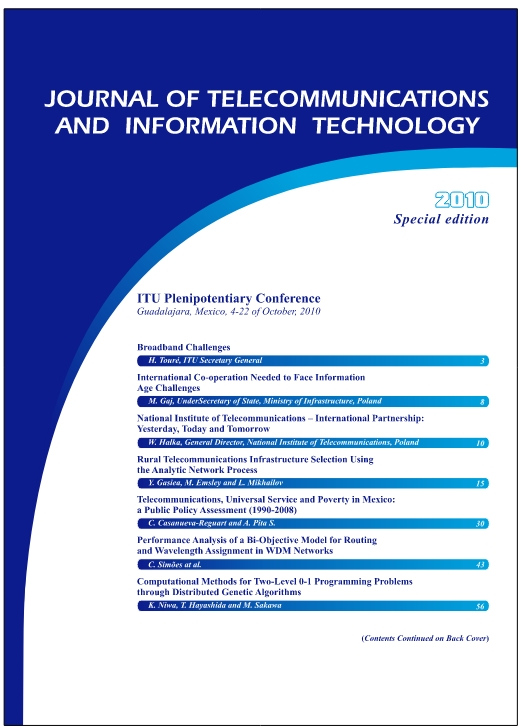
ITU 2010 Plenipotentiary Conference Special Issue
Full Issue
ARTICLES FROM THIS ISSUE
-
Preface
Abstract
This special issue of the Journal of Telecommunications and Information Technology provides selected articles that have been published in this quarterly in recent years, with three exceptions. The first one is the acceptance speech by Hamadoun Touré, ITU Secretary General, at the ceremony of awarding him the title of Doctor Honoris Causa of the Wrocław University of Technology (Poland), on 14 September 2010 (reproduced with the kind consent of the author). The second exception is the foreword by Magdalena Gaj, Deputy Minister, Undersecretary of State in the Ministry of Infrastructure, Poland. The third one is the text by Wojciech Hałka, Director General, National Institute of Telecommunications, Poland, focused on international co-operation of the Institute, especially with the ITU. (...)
-
Broadband Challenges Acceptance Speech Presented at the Ceremony of Awarding Dr. Hamadoun Touré the Title of Doctor Honoris Causa of Wrocław University of Technology, Poland, 14 of September 2010
Abstract
Broadband Challenges Acceptance Speech Presented at the Ceremony of Awarding Dr. Hamadoun Touré the Title of Doctor Honoris Causa of Wrocław University of Technology, Poland, 14 of September 2010.
-
International Co-operation Needed to Face Information Age Challenges
Abstract
International Co-operation Needed to Face Information Age Challenges - a foreword from Magdalena Gaj, Deputy Minister, Undersecretary of State in the Ministry of Infrastructure, Poland
-
National Institute of Telecommunications – International Partnership: Yesterday, Today and Tomorrow
Abstract
National Institute of Telecommunications – International Partnership: Yesterday, Today and Tomorrow - a summary by Wojciech Hałka, Director General, National Institute of Telecommunications, Poland, focused on international co-operation of the Institute, especially with the ITU.
-
Rural Telecommunications Infrastructure Selection Using the Analytic Network Process
Abstract
The decisions involved in rural settings are of complex nature, with some aspects compounded by the presence of intangible criteria. Hence, a suitable approach is needed that can produce effective solutions. This paper describes the applicability of a multicriteria decision-making method, specifically the analytic network process (ANP), to model the selection of an appropriate telecommunications infrastructure technology, capable of deploying e-services in rural areas of developing countries. It aims to raise awareness among telecommunication planners about the availability of ANP, and to demonstrate its suitability to enhance the selection process. The proposed model is constructed based on concerned experts’ views of relevant selection criteria and potential technology alternatives. Its network structure caters for all possible dependencies and interactions among criteria and alternatives.
-
Telecommunications, Universal Service and Poverty in Mexico: a Public Policy Assessment (1990–2008)
Abstract
This article analyzes the design and implementation of telecommunications service policies targeted at the poorest regions of Mexico (1990–2008). It begins by defining universal access and service policies, their economic and social rationale. Secondly, it discusses the scope of public policies on universal service provision designed by Mexican authorities to achieve the goal of universal access. Thirdly, the paper analyzes the distributive effects of this set of policies among the poorest sectors of the population. The sources on which this research was based were two national surveys: the Household Income and Expenditure Survey (2008), and the Household Survey of the Access and Use of Information Technologies (2007). The additional information on regional economic development was based on the poverty indexes by the national population council and economic information given by Mexico’s Census Bureau. Additional use was made of the annual reports prepared by Ministry of Communications, statistics published by the Federal Telecommunications Commission and official documents prepared by the government agencies. Finally, a series of in-depth interviews was conducted with the former representatives of the Office of Rural Telephony. Finally, the article discusses, in the light of available evidence, possible explanations for the apparent failure of the universal service policy that was implemented to bring at least basic voice services to Mexico’s neediest.
-
Performance Analysis of a Bi-Objective Model for Routing and Wavelength Assignment in WDM Networks
Abstract
Establishing end-to-end connections on wavelength division multiplexing (WDM) networks requires setting up lightpaths, defining the sequence of optical fibres and the wavelength in each fibre (the routing and wavelength assignment problem) for traffic flow. This paper reviews a bicriteria model for obtaining a topological path (unidirectional or symmetric bidirectional) for each lightpath request in a WDM network, developed by the authors, and presents a performance analysis of the model by considering important network performance measures. An extensive performance analysis of the two bicriteria model is presented, comparing the performance metrics obtained with the monocriterion models using the same objective functions, in five different reference networks commonly used in literature.
-
Computational Methods for Two-Level 0-1 Programming Problems through Distributed Genetic Algorithms
Abstract
In this paper, we consider a two-level 0-1 programming problem in which there is not coordination between the decision maker (DM) at the upper level and the decision maker at the lower level. We propose a revised computational method that solves problems related to computational methods for obtaining the Stackelberg solution. Specifically, in order to improve the computational accuracy of approximate Stakelberg solutions and shorten the computational time of a computational method implementing a genetic algorithm (GA) proposed by the authors, a distributed genetic algorithm is introduced with respect to the upper level GA, which handles decision variables for the upper level DM. Parallelization of the lower level GA is also performed along with parallelization of the upper level GA. The proposed algorithm is also improved in order to eliminate unnecessary computation during operation of the lower level GA, which handles decision variables for the lower level DM. In order to verify the effectiveness of the proposed method, we propose comparisons with existing methods by performing numerical experiments to verify both the accuracy of the solution and the time required for the computation.
-
A Framework for Evaluation of Communication Bandwidth Market Models
Abstract
The article presents a method of analysis of marketbased models for resource allocation in communication networks. It consists of several stages: classification of a market model, generation of input data, data adaptation to a tested model, test calculations and, finally, presentation and interpretation of results. A set of general criteria to assess various models has been proposed. Tests are run using dedicated computer applications, data is stored in open XML-based format originated in the multicommodity market model. Network topologies are derived from the SNDlib library.
-
Performance Analysis of Hybrid Phase Shift Keying over Generalized Nakagami Fading Channels
Abstract
In addition to the benefits of hybrid phase shift keying (HPSK) modulation in reducing the peak to average power ratio of the transmitted signal to reduce the zero crossings and the 0◦-degree phase transmissions, HPSK enhances the bit error rate (BER) measure of the signal performance. The constellation of the HPSK is analyzed, and an expression for the conditional probability of HPSK modulation over additive white Gaussian noise (AWGN) is derived. This BER measure of HPSK is shown to outperform quadrature phase shift keying (QPSK) modulation. HPSK performance through Nakagami – m fading channel is also considered.
-
Charging Phenomena at the Interface Between High-k Dielectrics and SiOx Interlayers
Abstract
The transition regions of GdSiO/SiOx and HfO2/SiOx interfaces have been studied with the high-k layers deposited on silicon substrates. The existence of transition regions was verified by medium energy ion scattering (MEIS) data and transmission electron microscopy (TEM). From measurements of thermally stimulated current (TSC), electron states were found in the transition region of the HfO2/SiOx structures, exhibiting instability attributed to the flexible structural molecular network expected to surround the trap volumes. The investigations were focused especially on whether the trap states belong to an agglomeration consisting of a single charge polarity or of a dipole constellation. We found that flat-band voltage shifts of MOS structures, that reach constant values for increasing oxide thickness, cannot be taken as unique evidence for the existence of dipole layers.
-
Channel Identification Using Chaos for an Uplink/Downlink Multicarrier Code Division Multiple Access System
Abstract
A scheme of chaotic spreading sequence for multicarrier code division multiple access system (MC-CDMA) is proposed to estimate the transmission channel. This system spreads spectrum and identifies the channel, simultaneously. The proposed scheme uses a chaotic sequence generated by a logistic map as a training signal and estimate channel parameters according to dynamics of the chaotic sequence. Encoding data by chaotic sequences is first built and then the orthogonal codes are used to spread the encrypted data for multiusers scheme. At the reception, first the channel parameters are identified using a training chaotic sequence in order to equalize the received data, and then the encrypted information is decoded for the desired user. The studies reveal that the proposed system (chaos plus orthogonal codes) significantly outperforms the Walsh- Hadamard code spreading in MC-CDMA system. The performance of the system is considered in the multiuser case by means of simulation. The simulation result shows that the proposed chaotic code spreading approach for channel identification achieves significant improvement in the channel identification, comparing to using others training sequence or the least square method.
-
The Design of 4×4 Multimode Interference Coupler Based Microring Resonators on an SOI Platform
Abstract
This paper would like to propose a novel microring resonator based on 4×4 multimode interference (MMI) couplers. The device acts as two separate microring resonators just in one structure. The transfer matrix method and the three dimensional beam propagation method (3D-BPM) are used to verify the working principle of the device. The device is then designed on silicon on insulator (SOI) technology. This device may be a very promising building block for optical switches, filters, add-drop multiplexers, delay lines and modulators.
-
Percolation Driven Flooding for Energy Efficient Routing in Dense Sensor Networks
Abstract
Simple flooding algorithms are widely used in ad hoc sensor networks either for information dissemination or as building blocks of more sophisticated routing protocols. In this paper a percolation driven probabilistic flooding algo- rithm is proposed, which provides large message delivery ratio with small number of sent messages, compared to traditional flooding. To control the number of sent messages the proposed algorithm uses locally available information only, thus induces negligible overhead on network traffic. The performance of the algorithm is analyzed and the theoretical results are verified through simulation examples.
-
A Microscopic Approach for THz Intersubband Challenges
Abstract
The main candidate to be a practical and low cost high power THz source is the intersubband-based quantum cascade laser, which can have a tremendous impact in many practical applications, including last mile and indoor telecommunication systems. In this review we discuss current challenges for THz intersubband device development from a microscopic point of view. Next summarize the search for new mechanisms and structure designs that can lead to intersubband gain without population inversion. This is a very important topic of current research, since is both an extremely elegant phenomenon from the basic physics of view and crucial for effective lasing in the THz range. The reason is that scattering phenomena can lead to level broadenings of the same order of magnitude of the lasing transitions, making population inversion by carrier injection in upper lasing subbands extremely difficult. Previous work in the literature is compared and contrasted with a new scheme that may lead to high temperature lasing by engineering the nonequilibrium population inversion with a combination of band structure and many body effects mediated by a k-space filter.
-
Impact of Signaling System Performance on QoE in Next Generation Networks
Abstract
The first experience of quality by multimedia applications’ users takes place during the setup phase of a new connection. If the setup phase is not accepted or “slowly accepted”, the confidence of the user decreases. The user becomes more sensitive when he/she pays the connections with assured quality of service (QoS). In this case, the process of call request should be also accomplished with QoS guarantees. This paper presents the signaling sub-system implemented within the EuQoS system. The EuQoS signaling process follows main assumptions of next generation networks (NGN) architecture and performs tasks related with codec agreement between multimedia end users, admission control and resource reservation functions. In this paper, we present analytical, simulation and experimental results showing the impact of signaling system performance on quality of experience (QoE) for the potential users of multi-layer EuQoS system. In particular, the presented approach aims at ensuring user QoE of the connection setup phase by ensuring QoS for transferring signaling messages by the network.
